Author: Joseph Carrizales CRE This post originally appeared on Joseph Carrizales CRE Market Reports and is republished with permission. Find out how to blog with us on theBrokerList.
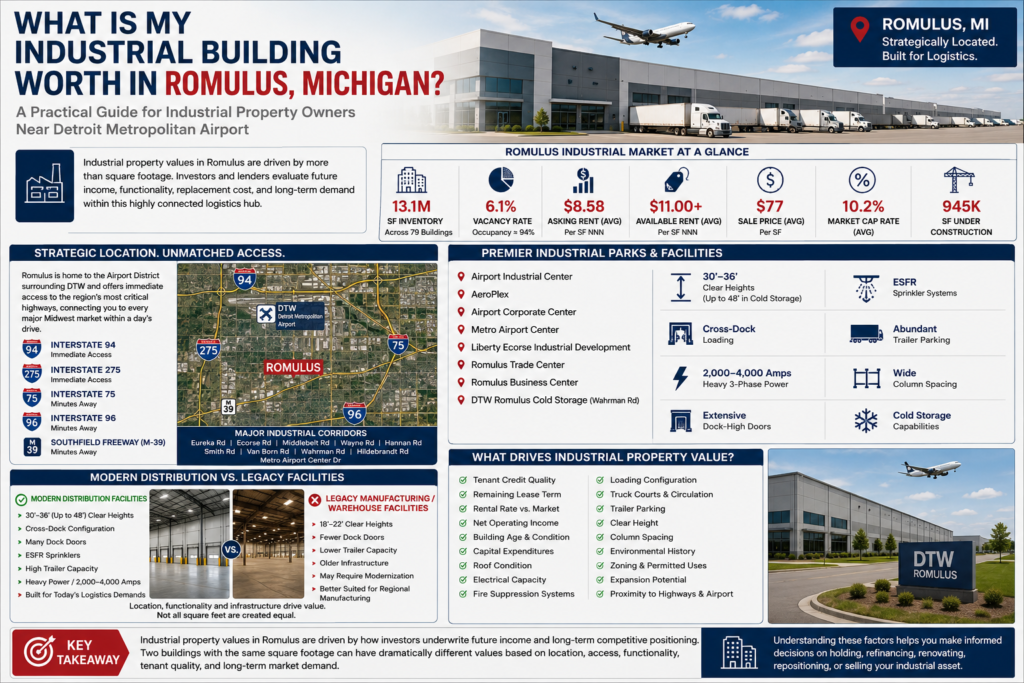
A Practical Framework for Industrial Property Owners Near Detroit Metropolitan Airport
Prepared by Joseph Carrizales | Marcus & Millichap | Southfield, Michigan
Industrial property owners in Romulus often begin with a simple question: what is my building worth? The answer, however, is rarely found by applying an average price per square foot. Industrial real estate is valued according to how investors, lenders, owner-users, and institutional buyers evaluate future income, functionality, replacement cost, and long-term demand within a specific submarket.
Strategic Location Overview
Romulus occupies one of the most strategically important logistics locations in the Midwest. Home to the Airport District surrounding Detroit Metropolitan Wayne County Airport, the city provides immediate access to Interstate 94, Interstate 275, Interstate 75, Interstate 96, and the Southfield Freeway, allowing freight to reach virtually every major Midwest market within a day’s drive.
Industrial corridors along Eureka Road, Ecorse Road, Middlebelt Road, Wayne Road, Hannan Road, Smith Road, Van Born Road, Wahrman Road, Hildebrandt Road, and Metro Airport Center Drive continue to attract logistics, aerospace, automotive, advanced manufacturing, and cold storage users.
Current Market Fundamentals
Today’s market reflects Romulus’s strategic positioning at the intersection of interstate freight networks and airport-adjacent logistics demand. The following metrics summarize current submarket conditions:
| Total Industrial Inventory | ≈ 13.1 million square feet / 79 buildings |
| Vacancy Rate | ≈ 6.1% |
| Occupancy Rate | ≈ 94% |
| Average Asking Rent | ≈ $8.58 per square foot |
| Available Asking Rent (top tier) | $11.00+ per square foot |
| Average Sale Price | ≈ $77 per square foot |
| Market Capitalization Rate | ≈ 10.2% |
| Under Construction | ≈ 945,000 square feet |
Nearly 945,000 square feet remains under construction, demonstrating continued developer confidence despite moderating absorption.
Functionality Drives Value: Modern Distribution vs. Legacy Product
What separates one Romulus industrial property from another is not simply its size but its operational capability. Modern distribution facilities within Airport Industrial Center, AeroPlex, Airport Corporate Center, Metro Airport Center, Liberty Ecorse Industrial Development, Romulus Trade Center, Romulus Business Center, and the newly developed DTW Romulus Cold Storage project illustrate the premium investors place on functionality.
The recently completed cold storage facility on Wahrman Road offers a 48-foot clear height, heavy power infrastructure, and dedicated trailer parking designed for temperature-controlled logistics — a specification profile that commands materially different underwriting than legacy product.
| Characteristic | Modern Distribution Product | Legacy 1970s–1980s Product |
| Clear Height | 30–36 ft (up to 48 ft cold storage) | 18–22 ft |
| Electrical Service | 2,000–4,000 amps, three-phase | Legacy manufacturing-era capacity |
| Loading Configuration | Cross-dock, extensive dock-high positions | Fewer dock doors, limited trailer capacity |
| Fire Suppression | ESFR sprinkler systems | Often requires system upgrades |
| Primary Use Fit | E-commerce, cold storage, national logistics | Regional manufacturing, owner-user |
While legacy buildings continue to satisfy many industrial users, institutional buyers frequently adjust pricing based upon modernization costs, truck circulation, ceiling heights, and future tenant flexibility.
What Institutional Buyers Actually Underwrite
For industrial owners, valuation increasingly depends on factors extending well beyond replacement cost. Investors evaluate tenant credit quality, remaining lease term, rental rate relative to market, net operating income, capital expenditures, building age, roof condition, electrical capacity, fire suppression systems, loading configuration, environmental history, zoning, and expansion potential, alongside proximity to transportation infrastructure.
A fully leased warehouse with long-term investment-grade tenancy near Metro Airport may command materially different pricing than a similarly sized owner-occupied manufacturing building requiring significant capital improvements — even where the two buildings share comparable square footage.
Conclusion
Ultimately, industrial property values in Romulus are determined by how the investment community underwrites future income and long-term competitive positioning. Two buildings containing identical square footage may produce dramatically different values because one offers immediate access to interstate logistics networks, modern distribution specifications, and institutional-quality functionality, while another serves a narrower user base.
Understanding these distinctions provides owners with a more accurate framework for evaluating whether to hold, refinance, renovate, reposition, or sell an industrial asset in one of Southeast Michigan’s most strategically significant industrial markets.